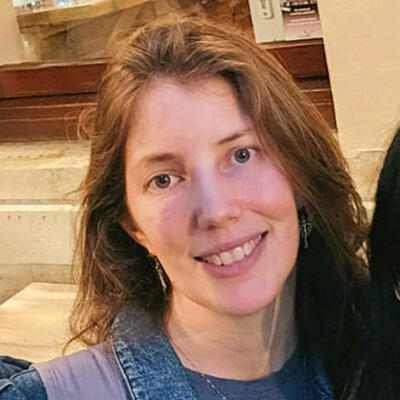
Hi🌻I’m Ana Núñez.A Game Designer turning ideas into satisfying and meaningful experiences. I focus on mechanics and systems, game feel, fast prototyping, and player-driven iteration.
✦ Entertainment ✦
Mechanics · Systems · Level Design · Playtesting

✦ Applied Games ✦
Research · Education · Accessibility · Therapy
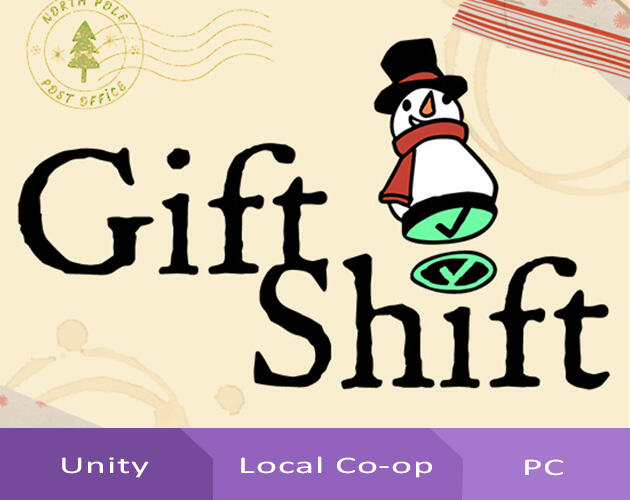
✦ Gift Shift ✦
Winner — selected from 40 course projects


My role: Game Designer & Producer
Unity · Local Co-op Game · PC · Six-person team · Feb - May 2026
Gift Shift is a playful local co-op party game where 2-4 players take on the role of living Christmas ornaments, helping Santa process children’s letters.As Game Designer, I worked on level design, progression, and game feel. Throughout development, I used player feedback to identify areas where the game was unclear, frustrating, or simply not as satisfying as intended.



Game Feel
Because our characters have no arms or legs, we built the core movement around jumping and ground-pounding. This constraint became an important part of the game's identity, as we designed the gameplay around what the characters could do.While I did not implement the mechanics myself, I continuously evaluated landing, jumping, and interaction with objects, to identify opportunities to enhance the wooden, tiny and festive nature of the characters.I translated these observations into concrete feedback and tasks for the team, from fine-tuning mechanics to requesting visual effects, haptic feedback, animations, and changes to the behavior of interactable objects.
Level Design
With 2–4 players acting simultaneously in the same space and working through multiple tasks, the level quickly became visually cluttered, and players lost track of their objectives.I structured the level so key interactable props pulled players towards the sides of the screen, while keeping the middle simpler. This gave players more room to move and switch between tasks without overcrowding the shared screen.


Dynamic Lobby
Playtesting showed that players generally understood where to go, but were confused about the order in which tasks needed to be completed, as most of them were not reading the game instructions.To address this, I turned the lobby into a playable onboarding experience. Instead of introducing all interactions at once, I used the space to let players discover the game's interactions and task order step by step before entering the main game.Subsequent playtests showed that this helped players to discover the task order without relying on the written instructions, while also improving team decision-making.
Task Progression & Balance
Gift Shift's gameplay loop is built around the execution of time-sensitive tasks. Orders arrive continuously, requiring players to: • Enter a code, select the correct toy and quantity
• Stamp completed orders
• Prevent documents from being shreddedThe tasks themselves are intentionally simple; the challenge comes from executing them using physics-based in-game devices, such as the keyboard and mouse, while managing multiple orders and hazards.Task progression was one of the most challenging aspects of development, as the balance changed significantly depending on the number of players. I iterated on the relationship between the overall timer, hazard frequency, and order lifespan, trying to find a balance that created enough pressure without becoming overwhelming.Due to production time constraints, we ultimately reached a good balance for 2 players, but higher player counts still requires further iteration.
Click here to read about Production



As Producer, I was responsible for sprint planning and tracking in HacknPlan, weekly reports, and keeping the team aligned with the project's vision from concept to final build. We had 11 weeks to develop the game, structured into three phases: • 3 weeks — Brainstorming: research and prototyping
• 6 weeks — Production: two 3-week production sprints
• 2 weeks — Polish: bug fixing, refinement, and final improvements

HackNPlan Burndown Charts


Protecting the core experience
As the scope became clearer during production, I identified features that were not essential to the core loop and removed them to ensure we could deliver a finished game within the deadline. One example was our hazard system. We originally planned six hazards across two categories: • Monitor hazards — Spam, Screensaver and Blue Screen
• Environment hazards — Cat, Spilled Chocolate and BlizzardWe kept the Spam and Screensaver hazards because they supported the game's storytelling and could be implemented without significant production cost. The environment hazards required substantially more work from the team, so I prioritized the Cat, as it added a quirky, unexpected element to the office setting.This allowed us to reduce production scope while preserving features that contributed most to the game's core loop, narrative, and personality.

Example of scope reduction

Visual Identity
I also contributed with the design of the game trailer, pitch, final presentation, and our Rookies submission, ensuring that the game visual identity stayed consistent.


✦ Racing Thoughts ✦

My role: Game Designer & Producer
Unity · Local Racing Game · PC & Mobile · Six-person team · In development
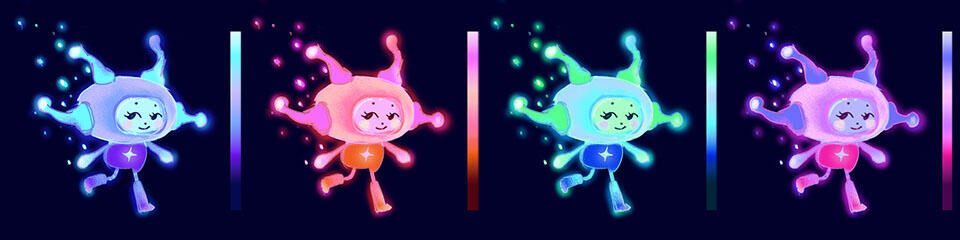
Racing Thoughts is a local two-player action racing game for PC that uses smartphones as motion controllers. The game combines fast-paced racing with the excitement of a theme-park ride, inviting players to compete in a surreal rollercoaster ride. The first ride, Galactic Bodies, takes players through an abstract interpretation of the human body.
Game Design Approach
As Game Designer I have been responsible for developing the initial concept prototype, with a particular focus on exploring the potential of smartphones as motion controllers.Unlike traditional racing games, players do not steer freely around the track. Instead, they are carried along a rollercoaster rail at a base speed where they can influence the race through intuitive tilt gestures performed with their smartphones. This design shifts the focus from steering towards timing, decision-making, and resource management, as players must decide: • When to spend their limited stamina to accelerate.
• When to jump to collect items, avoid obstacles, or disrupt an opponent.
• When to use collected items for the greatest advantage.Rather than making finishing position the only measure of success, the game rewards overall performance, encouraging players to balance speed, risk, resources, and interaction with their opponent.


Phone Controller
Using phones as motion controllers lowers the barrier to local multiplayer while creating a more playful and embodied form of interaction. The controls are designed around simple physical gestures rather than complex button combinations, allowing children, casual players, and experienced gamers to quickly understand the core mechanics and play together. The current control scheme includes: • Tilting forward → activates a temporary speed boost at the cost of stamina
• Shaking sideways → allows players to jump over obstacles or opponents
• Tilting backward → activates collected items.The goal is to make the relationship between physical movement and in-game action immediately understandable, while giving players enough control to make meaningful decisions during the race.

Level Design
The level is designed around continuous interaction between both players. Narrow, one-kart-wide sections force competitors to share the same racing space, creating opportunities to bump into each other and react to changing situations throughout the race. The track therefore acts not only as a route from start to finish, but also as a dynamic space for creating player interaction, tension, and decision-making.For Galactic Bodies, these mechanics are integrated into the surreal interpretation of the human body, turning the environment itself into part of the racing experience.
✦ More coming soon! ✦

✦ The Brittle Self ✦

My role: Game Designer & Solo Developer
Unity · Single-player slice game · PC & Mobile · Oct - Jan 2026
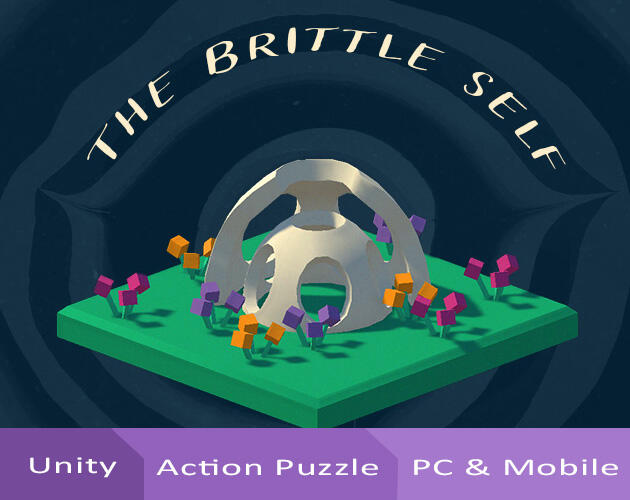
The Brittle Self is an abstract action-puzzle game built around a satisfying slicing mechanic. Using a concentric design approach, I progressively built the mechanics, systems, level structure, atmosphere, and emotional experience around this core action.


Core Action
Slicing responds to the direction and speed of the player's movement, physically cutting the mesh of 3D objects to reveal hidden layers and cores. Through extensive playtesting, I explored and iterated on how to make this action as tactile and responsive as possible. This process allowed me to expand the concept outwards, giving each layer of the design a purpose:
Slicing → Layered Objects → Entities → World Systems → Player Decisions


From destruction to protection
Players initially approached the game with the expectation that slicing was a destructive, aggressive action. They were not expecting it to become a tool for exploration, environmental manipulation, and protection. As the game's most vulnerable entity appeared, the baby, and enemies began pursuing it, player's attitude quickly shifted from mindless destruction to a sense of urgency and protectiveness.The meaning of the same action had changed. Players began balancing exploration, destruction, and protection while manipulating the environment to create a path to safety.
Solo Development
As a solo developer, I designed and implemented the core mechanic, gameplay systems, enemy behavior, level design, onboarding, UI, game feel, VFX, animation, and audio direction. This game concept allowed me to explore how a strong core interaction can grow into a complete experience through systems, feedback, and player-driven decision-making.


✦ Star Beat ✦

My role: Game Designer & 2D Artist
Unity · Educational game · Browser · 2025 - 2026
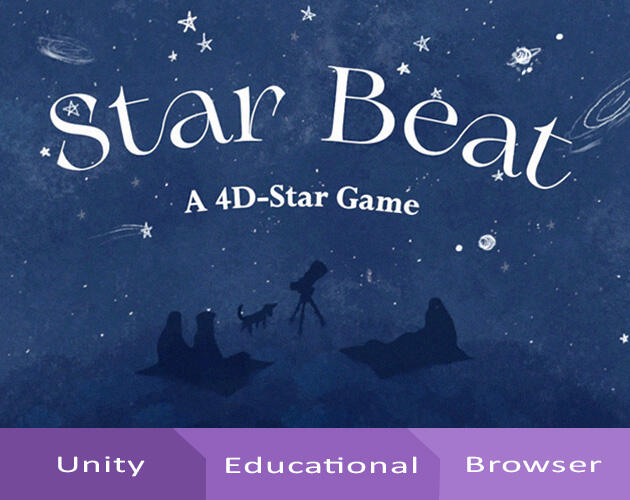
Star Beat is a browser puzzle game where players take on the role of an astronomy intern, matching frequencies to their corresponding star.The game is being developed for the 4D STAR Project at the Astronomy Faculty of KU Leuven. As part of a two-person team, I contribute as Game Designer and Artist.
Game Design Process
The design process started with a research paper on stellar oscillation frequencies measured by the Kepler mission, which served as the foundation for the game's scientific content and mechanics. I translated this research into a game loop, taking into consideration three core constraints:
• Players couldn't lose
• The game had to use real Kepler star data
• Players must learn how stars can be identified through their frequencies
The game combines a theoretical section, that translates scientific concepts into approachable content that players can read and learn at their own pace.

And a practical section, that lets players apply this knowledge by matching frequencies to stars in a non-punishing environment.


To deepen the connection between the player and the stars, I designed an unlockable room that presents the images of found stars alongside a sonified interpretation of their vibrations. This allows players to not only see the stars they identified, but also listen to their "heartbeat."

Art Direction
The game takes place in a whimsical depiction of an astronomy office. I designed it with careful attention to both the overall atmosphere and small details, aiming to create a space that could enchant players with a scientific background, while remaining inviting to those unfamiliar with astronomy.The tactile art style was handmade using Photoshop and Art Set, to make the scientific subject matter feel more approachable, balancing the technical nature of the content with a sense of curiosity and wonder.This project has not only deepened my understanding of the universe and its beauty, but also challenged me to translate scientific research and methodologies into engaging gameplay.
✦ Trail Seekers ✦

My role: Game Designer & Solo Developer
Unity · Casual game · Mobile · 1 month · 2026
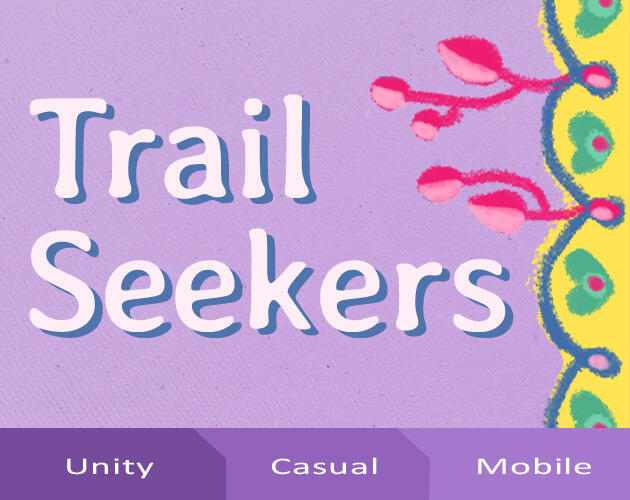
Trail Seekers is a single-player mobile exploration game designed around visuospatial attention, embodied interaction, and low-pressure gameplay. Players navigate by physically tilting their phone, discovering hidden patterns and leaving trails of flowers behind them as they explore.
This game concept emerged from a semester-long exploration of how trauma and cognitive research could be translated into concrete game mechanics. I created several prototypes every two weeks, testing different mechanics and approaches before converging on Trail Seekers.


Design Decisions
I initially experimented with mazes, target sequences, speed boosts, unlockable areas and navigation challenges. During playtesting, however, players repeatedly gravitated toward something much simpler: leaving their mark in the environment.The flower trail, which began as a feedback mechanic, proved more engaging than many of the systems I had built around it. I therefore shifted the design toward exploration and expression, making the act of leaving a trail central to the experience.
From there, I focused on creating mechanics that continuously demand visuospatial attention while remaining approachable during moments of distress. Each element of Trail Seekers was designed to reinforce this goal.
Tilt → Explore → Trace → Bloom


Why tilting?
I wanted movement to feel physical rather than purely digital. Tilting the phone makes navigation an embodied action and creates a direct relationship between the person and the game.Why pattern tracing?
Patterns create a simple objective that requires players to continuously observe, remember, orient themselves and navigate through space.Why flowers?
Flowers began as visual feedback but became an important part of the experience. They give players a visible record of where they've been and make their actions feel consequential.Why exploration instead of challenges?
I deliberately removed timers, enemies and fail states. The goal was to create engagement through curiosity and interaction rather than pressure.

From Trauma Research to Gameplay: Designing Trail Seekers
Around 70% of people globally will experience a potentially traumatic event during their lifetime. While most people recover without developing PTSD, some experience persistent symptoms, including intrusive memories of the event — World Health Organization
Trail Seekers explores how findings from cognitive trauma research can be translated into an accessible game experience for moments of distress.
Understanding the Research
Following a traumatic event, some people develop Post-Traumatic Stress Disorder (PTSD), a condition marked by intrusive memories: unwanted recollections that can feel vivid and involuntary, sometimes involving images, sounds, smells, or other sensory experiences. These memories can cause significant distress and interfere with everyday life. In 2024 the World Health Organization estimated that around 3.9% of the global population has experienced PTSD at some point.

Research suggests that traumatic visual memories relies on visuospatial working memory. This has led researchers to investigate whether engaging the same cognitive resources with a demanding visuospatial task can interfere with the formation or reactivation of intrusive memories under specific conditions.One proposed explanation involves memory reconsolidation. When a memory is recalled, it can temporarily become more malleable before being stored again. Introducing competing visuospatial demands during this period may affect how the memory is subsequently experienced. This mechanism is referred as cognitive interference. Tetris has been used extensively to investigate this idea:
• Holmes et al. (2009) proposed that playing Tetris after exposure to traumatic imagery could reduce later flashbacks. • Iyadurai et al. (2017) demonstrated promising results using a brief Tetris-based intervention shortly after traumatic events. • Kessler et al. (2020) found reductions in intrusive memories when visuospatial gameplay was used following memory reactivation.
However, these findings do not mean that any visuospatial game will have a therapeutic effect. Results depend on factors such as the task, timing, and experimental conditions, and the underlying mechanisms remain an area of ongoing research. This distinction became important to my design process.

Translating Research Into Design
I translated the findings mentioned above into three main design principles:1) Sustained visuospatial demand
The player should continuously observe, orient themselves and navigate through space rather than completing a single isolated cognitive task.2) Embodied interaction
The player's body should be integrated into the act of playing, creating a grounding physical connection.3) Low emotional arousal
The experience should avoid unnecessary pressure that could conflict with the intention of creating a calm, absorbing activity.These principles informed the mechanics and gameplay of Trail Seekers. Players physically tilt their phone to navigate, reconstruct partially visible patterns while moving through the environment, and leave trails of flowers behind them.

What I Learned
Playtesting challenged several of my original assumptions. I initially explored systems such as mazes, target sequences, speed boosts, unlockable areas and navigation challenges. Yet players repeatedly gravitated toward a much simpler interaction: leaving their mark in the environment.The flower trail had originally been designed as feedback, but it became one of the most engaging parts of the experience. This led me to simplify the design and make exploration and expression more central.I also noticed how quickly the phone stopped feeling like a device. Through tilting, movement became physical and playful. The phone transformed into something closer to a toy or extension of the player's body than a traditional interface.
Limitations and Future Work
Trail Seekers is a research-inspired prototype and has not been clinically tested. Because I could not access the intended target audience during development, my evaluation focused on non-clinical participants. I used a self-report survey to assess whether the game mechanics successfully generated the intended visuospatial and attentional demands.However, this evaluation could not establish whether Trail Seekers reduces intrusive memories, affects memory reconsolidation, or provides therapeutic benefit. Answering these questions would require controlled research with appropriate participants, methodology, and clinical expertise.Trail Seekers therefore represents a starting point: an exploration of how game design can translate emerging research into a gaming experience. I would love to collaborate with researchers, therapists, or healthcare institutions to investigate whether this design approach has measurable benefits.
Do you have any suggestions or relevant sources that might help the development of Trail Seekers? Please reach out to me🌻
Bibliography used for this project • Agren, T., Hoppe, J. M., Singh, L., Holmes, E. A., & Rosén, J. (2023). The neural basis of Tetris gameplay: Implicating the role of visuospatial processing. Current Psychology, 42(10), 8156–8163. https://doi.org/10.1007/s12144-021-02081-z • Asselbergs, J., Sijbrandij, M., Hoogendoorn, E., Cuijpers, P., Olie, L., Oved, K., Merkies, J., Plooijer, T., Eltink, S., & Riper, H. (2018). Development and testing of TraumaGameplay: An iterative experimental approach using the trauma film paradigm. European Journal of Psychotraumatology, 9(1), 1424447. https://doi.org/10.1080/20008198.2018.1424447 • Beckenstrom, A. C., Bonsall, M. B., Markham, A., Slade, O., Ramineni, V., Iyadurai, L., Islam, Z., Highfield, J., Jaki, T., Goodwin, G. M., Dias, R., Daniels, R., Malik, A., Summers, C., Kingslake, J., & Holmes, E. A. (2026). A digital imagery-competing task intervention for stopping intrusive memories in trauma-exposed health-care staff during the COVID-19 pandemic in the UK: A Bayesian adaptive randomised clinical trial. The Lancet. Psychiatry, 13(3), 233–247. https://doi.org/10.1016/S2215-0366(25)00397-9 • Butler, O., Herr, K., Willmund, G., Gallinat, J., Kühn, S., & Zimmermann, P. (2020). Trauma, treatment and Tetris: Video gaming increases hippocampal volume in male patients with combat-related posttraumatic stress disorder. Journal of Psychiatry & Neuroscience : JPN, 45(4), 279–287. https://doi.org/10.1503/jpn.190027 • Holmes, E. A., James, E. L., Coode-Bate, T., & Deeprose, C. (2009). Can playing the computer game “Tetris” reduce the build-up of flashbacks for trauma? A proposal from cognitive science. PloS One, 4(1), e4153. https://doi.org/10.1371/journal.pone.0004153 • Iyadurai, L., Blackwell, S. E., Meiser-Stedman, R., Watson, P. C., Bonsall, M. B., Geddes, J. R., Nobre, A. C., & Holmes, E. A. (2018). Preventing intrusive memories after trauma via a brief intervention involving Tetris computer game play in the emergency department: A proof-of-concept randomized controlled trial. Molecular Psychiatry, 23(3), 674–682. https://doi.org/10.1038/mp.2017.23 • James, E. L., Lau-Zhu, A., Tickle, H., Horsch, A., & Holmes, E. A. (2016). Playing the computer game Tetris prior to viewing traumatic film material and subsequent intrusive memories: Examining proactive interference. Journal of Behavior Therapy and Experimental Psychiatry, 53, 25–33. https://doi.org/10.1016/j.jbtep.2015.11.004 • Kanstrup, M., Kontio, E., Geranmayeh, A., Olofsdotter Lauri, K., Moulds, M. L., & Holmes, E. A. (2021). A single case series using visuospatial task interference to reduce the number of visual intrusive memories of trauma with refugees. Clinical Psychology & Psychotherapy, 28(1), 109–123. https://doi.org/10.1002/cpp.2489 • Kessler, H., Schmidt, A.-C., James, E. L., Blackwell, S. E., von Rauchhaupt, M., Harren, K., Kehyayan, A., Clark, I. A., Sauvage, M., Herpertz, S., Axmacher, N., & Holmes, E. A. (2020). Visuospatial computer game play after memory reminder delivered three days after a traumatic film reduces the number of intrusive memories of the experimental trauma. Journal of Behavior Therapy and Experimental Psychiatry, 67, 101454. https://doi.org/10.1016/j.jbtep.2019.01.006 • Lau-Zhu, A., Holmes, E. A., Butterfield, S., & Holmes, J. (2017). Selective Association Between Tetris Game Play and Visuospatial Working Memory: A Preliminary Investigation. Applied Cognitive Psychology, 31(4), 438–445. https://doi.org/10.1002/acp.3339 • Meyer, T., Brewin, C. R., King, J. A., Nijmeijer, D., Woud, M. L., & Becker, E. S. (2020). Arresting visuospatial stimulation is insufficient to disrupt analogue traumatic intrusions. PLOS ONE, 15(2), e0228416. https://doi.org/10.1371/journal.pone.0228416
✦ Klink & Klank ✦

My role: Producer & Project Manager
Unity · Local Inclusive Game · Tablet · Ten-person team · Sep - Dec 2026
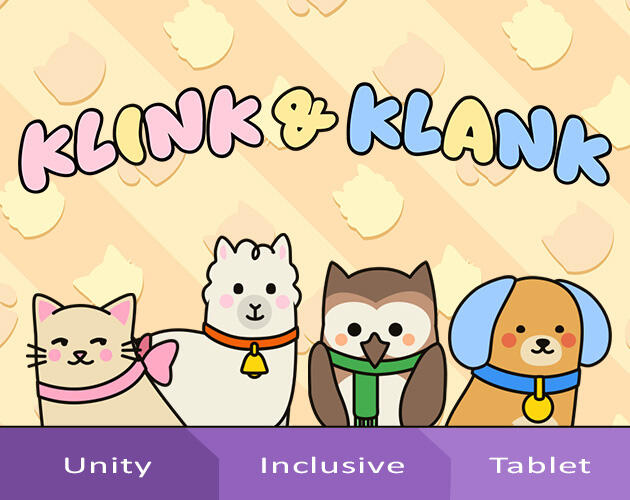
Klink & Klank is an inclusive local competitive party game for 2–4 players. Each player uses a button positioned at the corner of the screen to collect different items emerging from a spinning central disc.This game was developed in collaboration with VIRO, a social enterprise in Bruges (Belgium) that supports people with disabilities. Our goal was to create an engaging experience that could challenge and empower the people in their care, while remaining accessible to a diverse range of players.



As Producer and Project Manager, I was responsible for production planning, client communication, progress tracking, weekly reporting, and keeping the team aligned with the client's vision and accessibility requirements. I also worked closely with the design, art, and development teams, supporting the entire production process.We had 11 weeks to develop the game, which was structured into three milestones: • 5 weeks — Pre-Production: research, prototyping and design direction
• 4 weeks — Production: playtest, development and early showcase
• 2 weeks — Polish: bug fixing and final improvements
To keep the project on track, I structured our production pipeline, monitored team capacity, tracked milestone progress, and adjusted priorities as the project evolved. I also organized regular playtesting sessions with our target users, using their feedback to guide both design decisions and production priorities.


Visual Identity
I also contributed with the design of the game trailer, pitch, final presentation, and game design document, ensuring a consistent visual identity.


✦ Purrpal Quest ✦
Winner — CrossXTech Hackathon Mons 2025


My role: Game Designer & Developer
Unity · Therapeutic Game · Mobile · Five-person team · 48hrs · 2025
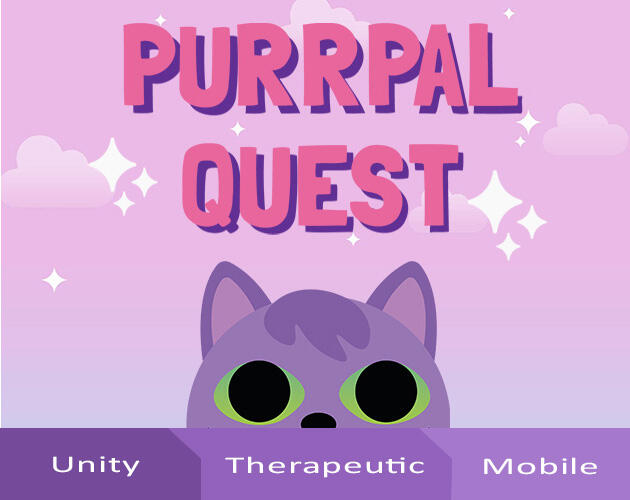
In collaboration with Jenna Duponchelle, founder of Selective Mutism Belgium ASBL, and a five-person team including a neuropsychologist, we developed a mobile game concept to support children with Selective Mutism.Selective Mutism is an anxiety disorder that can make speaking in specific social situations extremely difficult. I explored how game design could transform the existing Gradual Exposure methodology used in therapy into a more accessible and rewarding gaming experience for children.

Design Approach
Exposure needed to feel positive, motivating, and rewarding, rather than being perceived purely as a therapeutic task. I took inspiration from Duolingo's progression and reward systems: instead of language exercises, the player completes gradual communication challenges based on everyday school situations.The game features a customizable character that acts as a visual representation of the player's progress. Completing challenges unlocks accessories that the player can use to dress up their character, giving children a sense of achievement and ownership over their journey.


48-Hour Prototype
I worked across both game design and development, rapidly prototyping the core recording mechanic and progression systems in Unity. Within the limited timeframe, our priority was to validate whether the concept could translate the therapeutic methodology into an engaging game loop.The concept was selected as one of the three winners of the CrossXTech Hackathon for further development.

[ About ]

I'm Ana — Anita to friends.🌻Originally from Chile, I moved abroad at 32 with my husband, two suitcases, and a clear sense of what I wanted to make: games that make learning feel like play, healing feel a little less heavy, and spark the kind of curiosity you didn’t know you had!
That’s what drew me to game design. I love turning ideas into satisfying, meaningful game experiences that players can connect with. Thinking about how mechanics, systems, and small details can shape the way someone feels, thinks, and plays.With a background in graphic design and project leadership, I bring a blend of creative direction, visual identity, interdisciplinary collaboration, and production experience to my work.I’m currently pursuing a Bachelor’s degree in Independent Game Production at Digital Arts & Entertainment – Howest, and looking for a Game Design internship (H1 2027).
When I’m not in production mode, I’m usually working with my hands: collecting small things, crafting pipe-cleaner teddy bears, or upcycling clothes. There’s something about making tangible, careful things that keeps me grounded.
You can always count on me.🌻

Cosmic Corsairs
My role: Producer & Art Direction
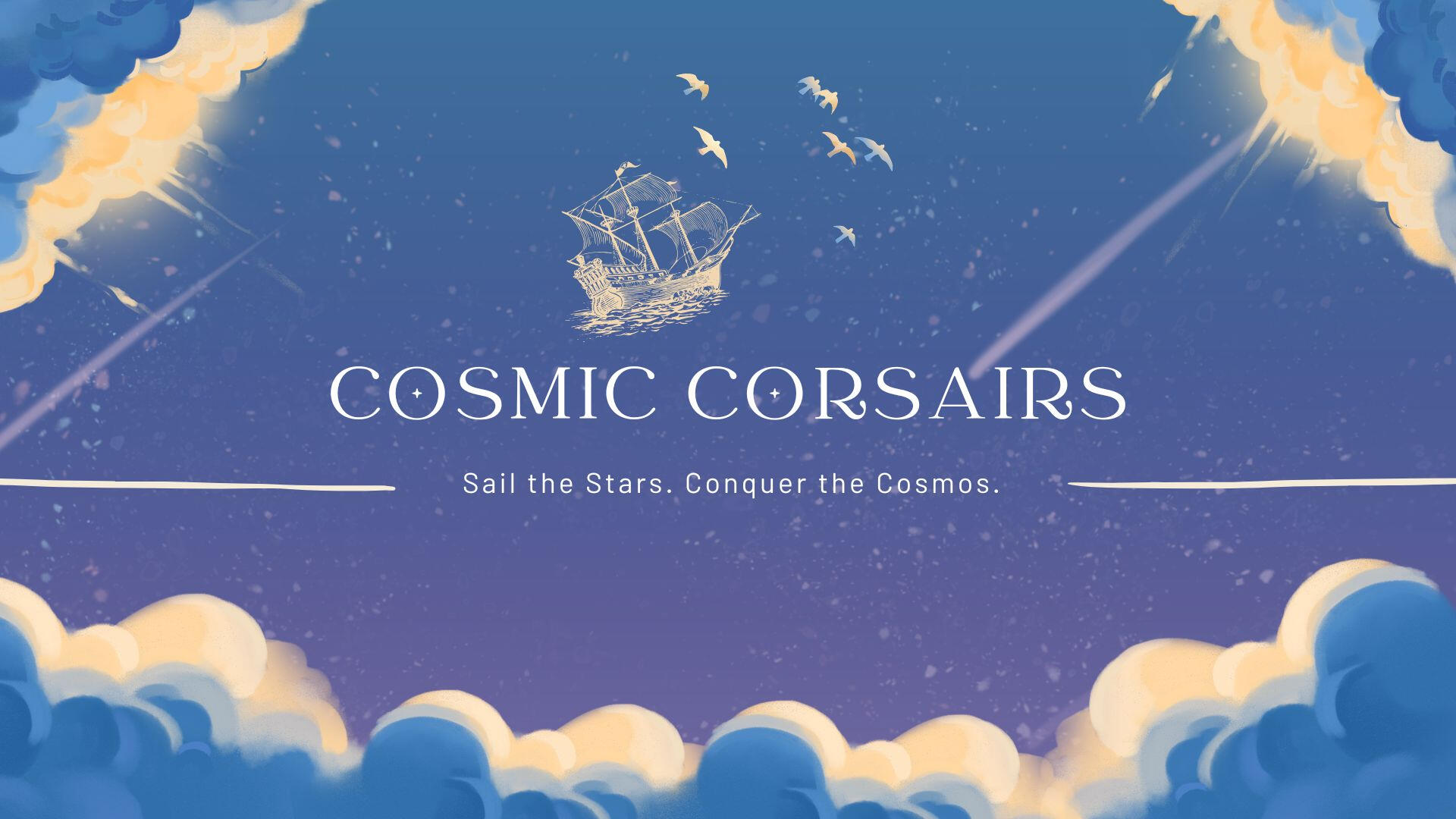
Deck building game (concept) | 2024At Shuffle Studios, I worked in a team of six as Art Director and Creative Producer on Cosmic Corsairs, a deck-building roguelike video game concept with physical cards. I led team organization and created key deliverables, including the business plan and investor pitch, while contributing to the game’s concept and visual direction. Our project was highly evaluated by private investors during a faculty-organized pitching session.
Business Plan


[2D Game Art]
🌻My skills: Style Guide & Art Bible creation - UI - Wireframes🌻Software I use: Photoshop, Illustrator, Canva, Figma


A Healer's Diary
DAE - Graphics Fundamentals
Analysis & Style guide for UI and Screens | Exam 2024I created the UI elements and screens for an imaginary game, based on the illustration "HiFi Festival" by Krzysztof Nowak. I chose a moody fairy theme, for a nomad fairy doctor that heals ill animals around different villages.I loved the challenge of conveying a game concept using limited amount of screens and visual elements, while trying to add a personal touch to an already defined style.


Topos-Trópos Bathhouse
DAE - 2D Graphics
Art Bible for a fictional game | Exam 2024"You come across an enigmatic society, living in a surreal and out of scale environment. Interact with this new ecosystem, and lose yourself in its wonders."I loved the freedom this assignment gave me, as I was free to explore and embrace my creative process. Falling in love with the shape of a lettuce was a fun and interesting design choice, which intensified my creativity.


Okami Art Bible
DAE - 2D Graphics
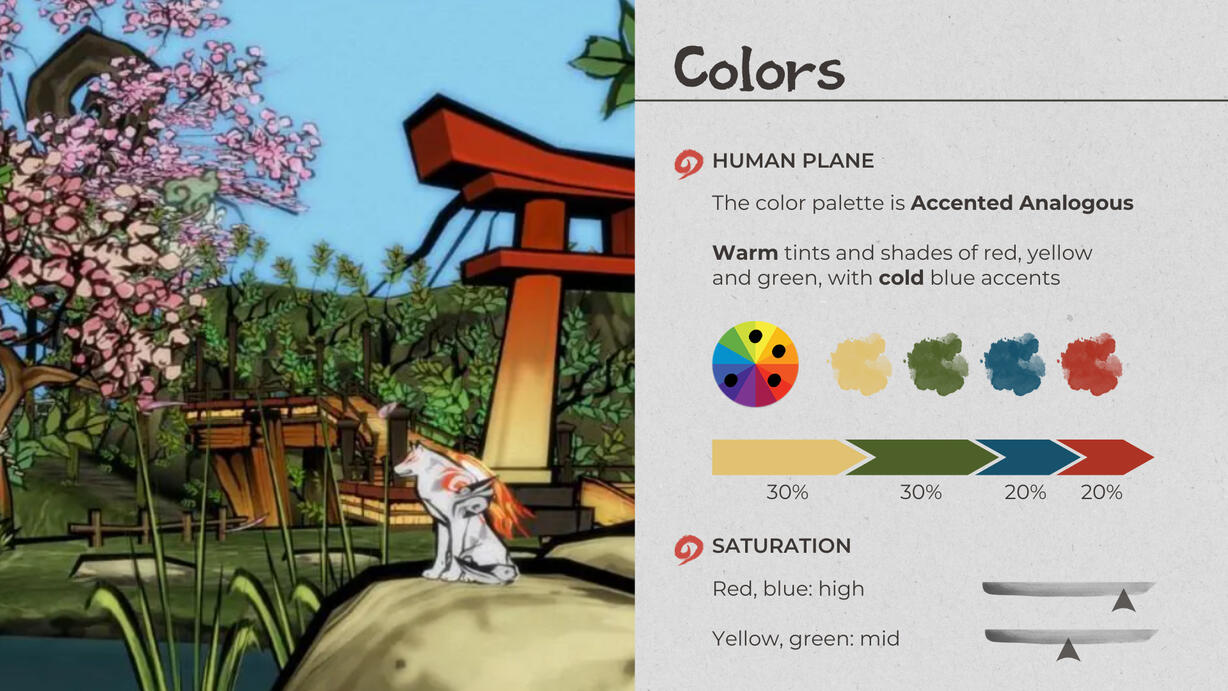
Reverse Engineered Art Bible | 2024With this assignment I learned how to analyse all the visual elements of an existing game. It also taught me the importance of defining clear guidelines and pillars for team members, to develop a consistent project.
[3D Game Art]
🌻My skills: Full pipeline for low & mid-poly game asset creation🌻Software I use: Substance 3D Painter, Blender, Unity


Bloom Dash
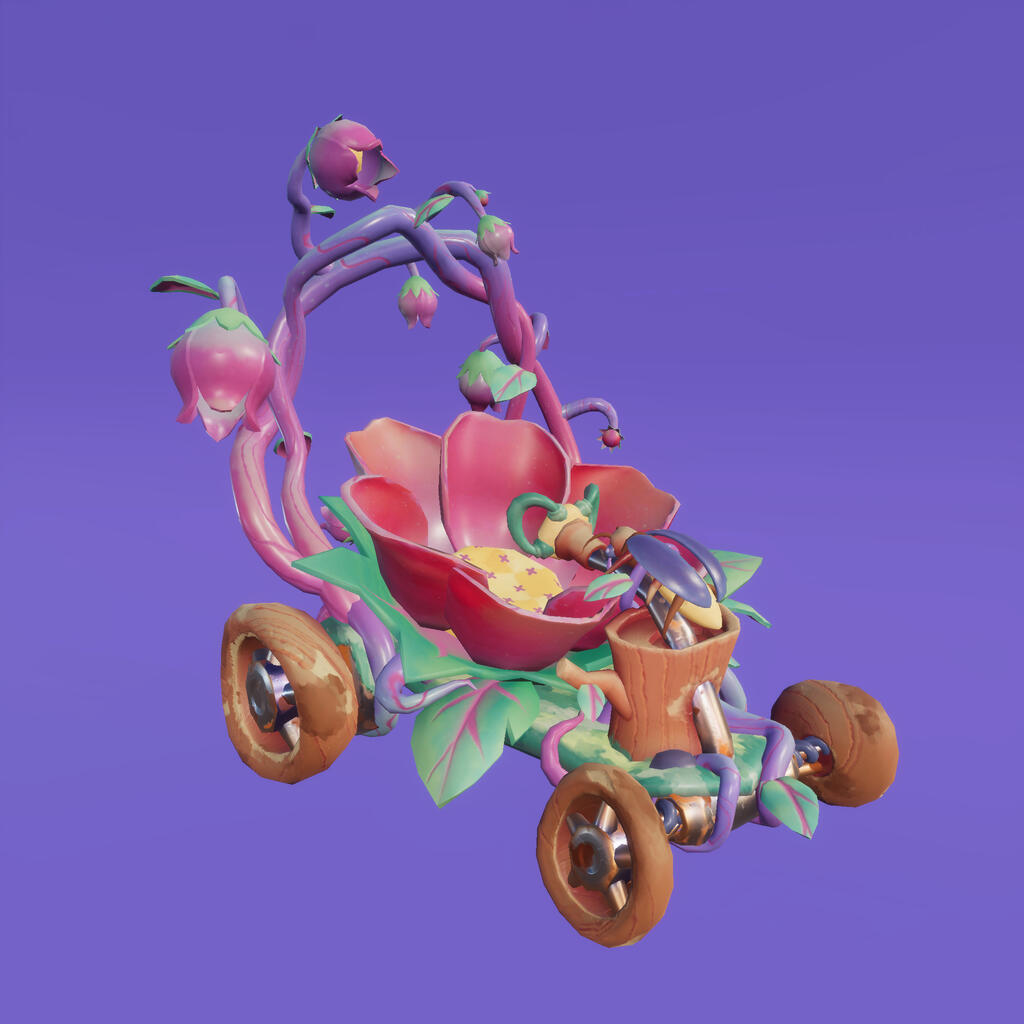
PBR Game Asset in UnityThis was a fully developed game asset creation, from concept to implementation in Unity. It was modelled, rigged and animated in Blender, baked and textured in Substance Painter using PBR texturing.

Windmill
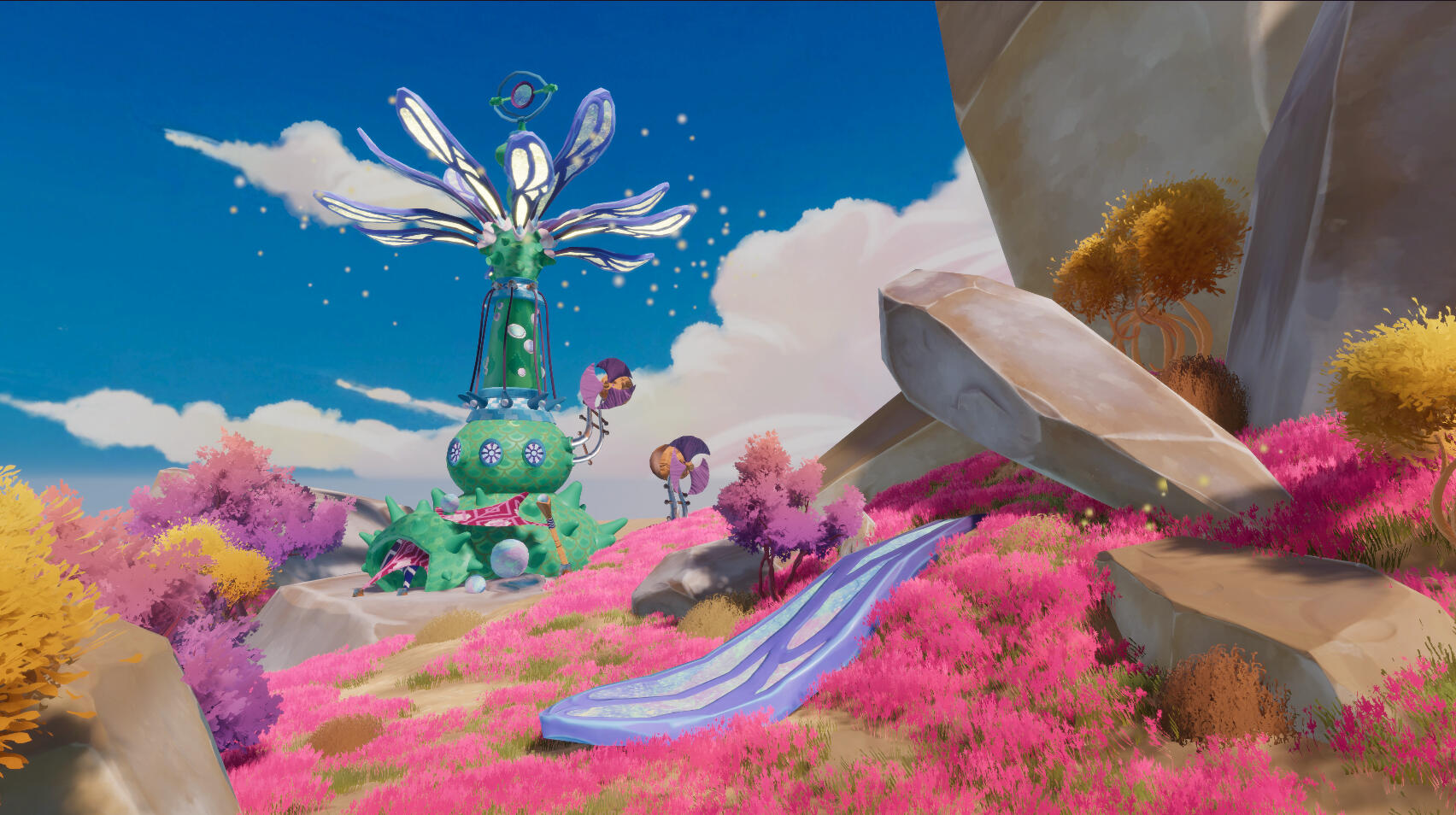
HDRP Environment in UnityThis was my first try at creating a modular asset kit, learn about sculpting, and apply different texturing techniques like unique and trim sheet textures. I continue polishing my shaders and materials in Unity as well.


Toy Village
HDRP Environment in UnityFor this assignment I had the opportunity to improve on my asset modelling, sculpting, different texturing techniques like unique and trim sheet textures, shader and material creating in Unity. I also polished my lighting and scene optimisation.


CuppyBot
PBR Character Game AssetI was taught mid-poly to low-poly workflow in Blender, using bevel weight and modifiers. I also tried my first baking and stylized texturing! Cuppy was modelled, rigged and animated in Blender, baked and textured in Substance Painter using PBR texturing.
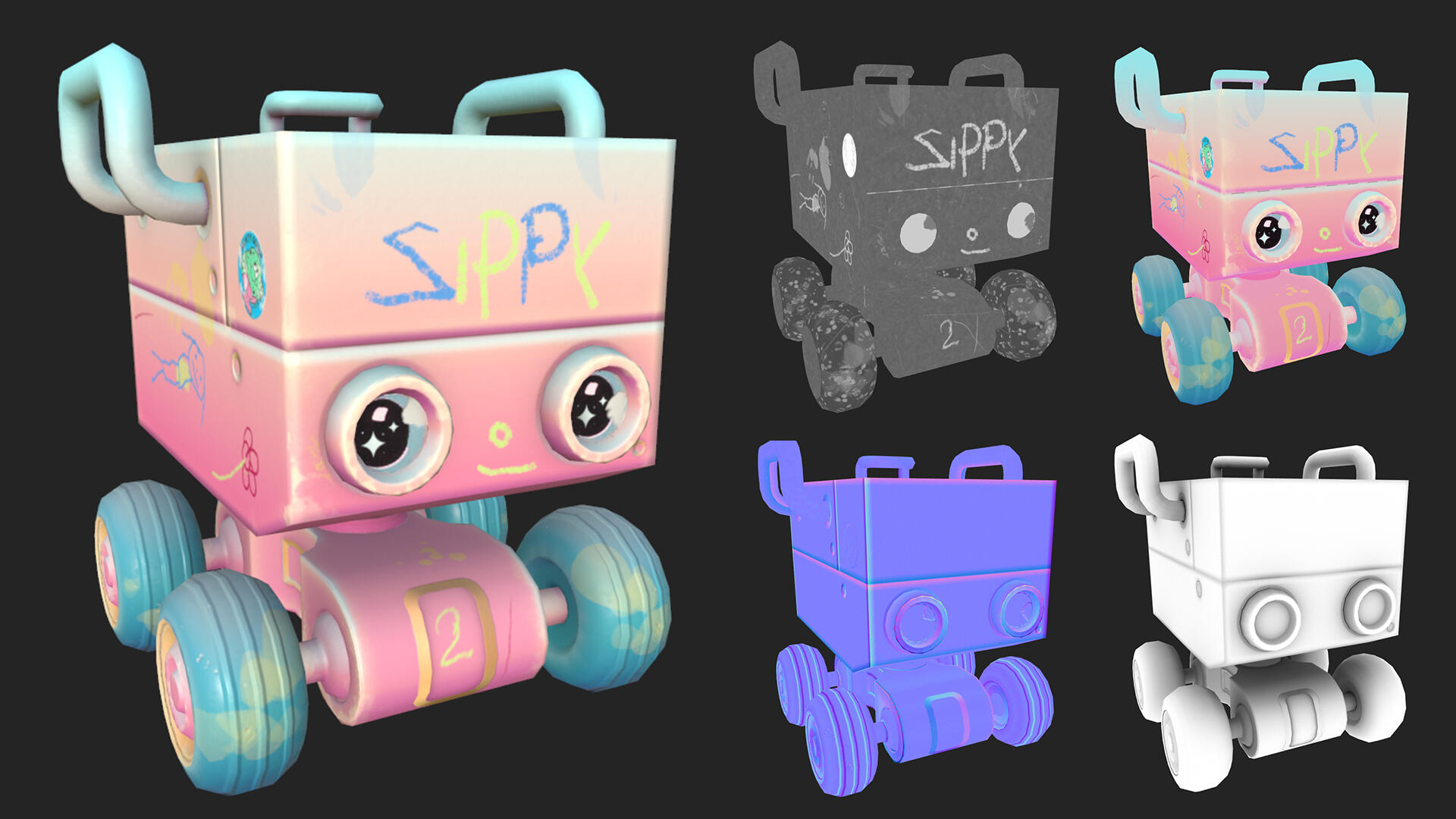
Zippy
Stylized Texturing ExerciseI received zippy as a finished model and had to use my imagination to give it a personality in a stylized style. I learned the importance of gradients and intentional use of colors. Zippy was baked and textured in Substance Painter using PBR texturing, and rendered in Unity
[Game jams]
Game jams have not only tested and honed my skills, but also allowed me to meet amazing people who have shared their knowledge with me. It's one of my favorite environments to create and grow with others.


Starfall - The Sandbox July Jam 2024 [🏅Winner]
My role: Game Design, UI & Sound
Single-player atmospheric game (PC) | 3 daysThis was my first ever game jam and it pushed me out of my comfort zone. We worked at full speed in the middle of the hottest days of summer, pushing through several challenges to make our vision come true. To this day, it still has a special place in my heart. It was a joy to bring our vision of life and death into a hand painted dreamy game concept. I assisted with the sound design, UI and game design.


Chapi, No! - Global Game Jam Antwerp 2025
My role: 2D art, UI & Sound
Single-player platform game (PC) | 2 daysTogether with 2 classmates, we worked on a funny and quirky concept. Inspired by the jam's theme "Bubbles", we developed this cute 2D platformer where you play as Chapi, a dog on a bubble frenzy! I contributed with the 2D art, sound, and UI.

The Flying Freakshow - XBox Game Camp Belgium Jam 2026
My role: Creative Producer, UI and Sound
Local multiplayer party game (PC) | 2 daysWhat would you do for attention? Our team of 7 students across different majors turned that question into a chaotic party game with a dark twist. You play as a clown animal in a twisted circus, performing increasingly unhinged tricks, and compete with up to 4 players for the crowd's applause. The more it hurts, the louder they cheer.As a Creative Producer I kept track of progress and tasks, designed the UI and sound of the game, and helped with the production of the trailer and pitch.
✦ Personal Work ✦
🌻 Xylography - Collage - Sculpting - Decalcomania 🌻
Some ideas that have been quietly waiting in the background. For a long time, they lived inside folders and sketchbooks — now emerging, like seeds finally ready to sprout.


